

The evolution of Riblet technology
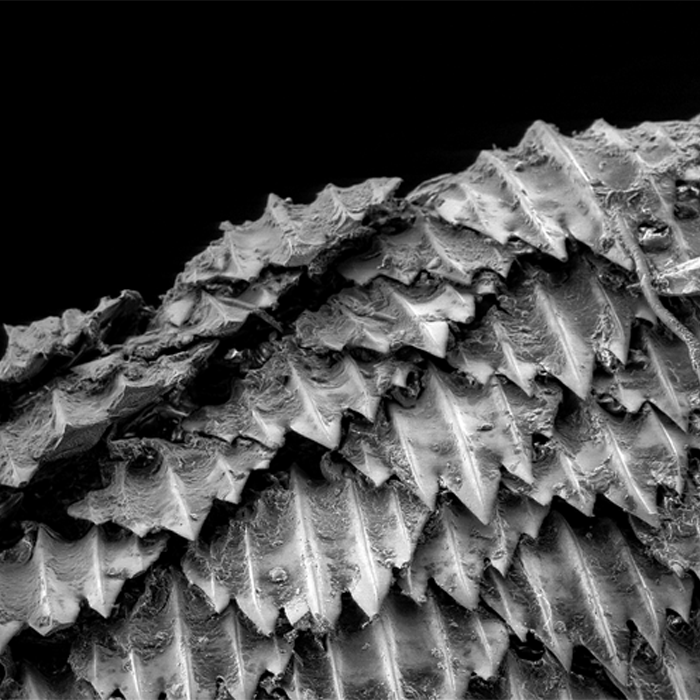
1930s
1960s
1970s
1980s
3M suggested, that Riblets should be molded on lightweight plastic film.
In 1987, the racing yacht 'Stars and Stripes 87’, equipped with Riblets from NASA and 3M, won the America's Cup.
Results of first experiments of Riblets on a Boeing airplane were published in 1987 by McLean et al. .
Airbus conducted experiments with Riblet film applied to an A320.
The effects of Riblets on flat plates and on boat hulls were investigated in wind tunnels and towing tunnels by Choi et. al. .
1990s
Koury & Virk conducted experiments on pipe flows and tested 3M foil in pipes.
In 1995 Goldstein et al. developed a numerical model to analyze a turbulent flow over a surface with Riblet structures.
Multiple experiments and flight tests on reducing aerodynamic drag with Riblets were led by the German aerospace engineer D. W. Bechert.
Bechert and his team won several international science awards for their work on Riblet surfaces.
2000s
In 2002, Brennan developed sharkskin inspired surfaces to prevent fouling of submarine and ship surfaces together with the US Office of Naval Research.
The Fraunhofer Institute for Manufacturing Technology and Advanced Materials (IFAM) investigated painted Riblets and holds a patent for the respective application technology.
IFAM tested the painted Riblets in terms of stability on an airplane in operation.
bionic surface technologies GmbH completed their first aerodynamic flight tests with a Zivko Edge 450 V2, which was fully covered with Riblets.
The effects of Riblets on flat plates and on boat hulls were investigated in wind tunnels and towing tunnels by Choi et. al. .
2010s
In the same year bionic surface technologies GmbH performed their first full scale wind tunnel test with a GT race car.
bionic surface technologies GmbH successfully realized Riblet applications in the DTM (Deutsche Tourenwagen-Masters), which brought significant performance advantages. Unfortunately, Riblets were banned from the DTM by regulations 3 years later in 2013.2012
bionic surface technologies GmbH conducted their first Riblet tests on a Formula 1 car.
IFAM and the Hamburg Ship Model Basin (HSVA) tested painted Riblets on ship surfaces. They indicated a possible drag reduction of 3,5% - 5%.
2013
IFAM and Lufthansa Technik performed their first durability tests of painted Riblets on a civil aircraft in service.
2014
Riblets, designed by bionic surface technologies GmbH, were used in bobsleigh races at the Olympic Winter Games 2014 in Sochi.
2015
Riblets were applied to aircraft at the Red Bull Air Race for the first time. The design and realization was performed by bionic surface technologies GmbH.
Eschmann Textures developed a scratch-resistant surface, inspired by sharkskin.
2018
The EU-funded research project ReSiSTant (“Large Riblet Surfaces with Super Hardness, Mechanical and Temperature Resistance by Nano Functionalization”) was started by bionic surface technologies GmbH, General Electric, MAN, Lufthansa and others.
2019
The Red Bull Air Race was discontinued in 2019. Until then, 49% of all podium positions and 51% of all victories were flown with Riblets.
2021
The athlete Dario Costa performed the world record breaking “Red Bull Tunnel Pass”. Equipped with Riblets on his Zivko Edge 540 V2, he flew through 2 highway tunnels with a total length of 2,26 km.
2022
SWISS became the first airline to use Riblet foil on a passenger airplane in regular operations with the BASF AeroSHARK technology. It saves over 1% in fuel consumption, meaning a yearly CO2 reduction of over 1200 tons per plane.